
Why using a betting site in Bangladesh just became a five-year prison risk
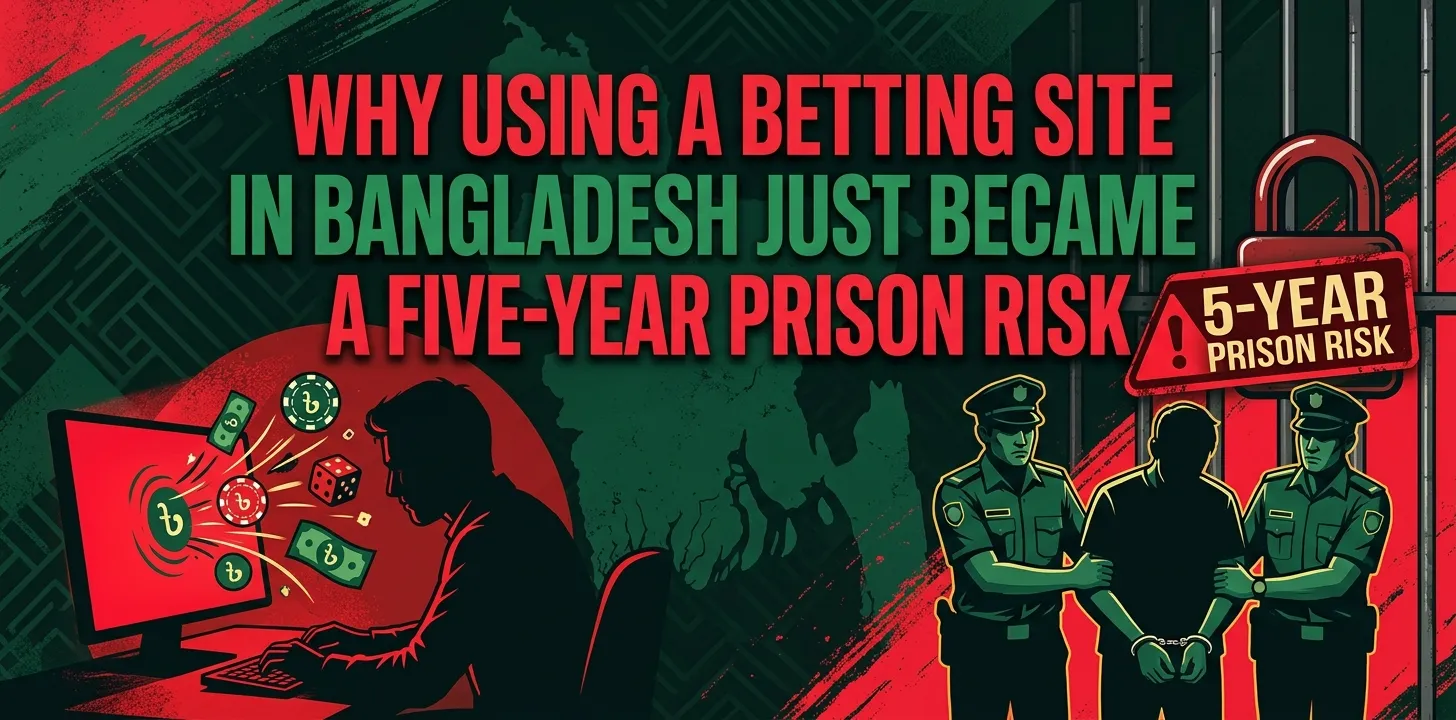
In July 2026, Bangladesh replaced a 159-year-old law that never once mentioned the internet with a statute written specifically for it. Anyone who has compared a list of https://tribuna.com/en/betting/betting-sites/bangladesh-bookmakers/ to find better cricket odds is now looking at platforms operating under a completely different legal reality than they were in June. The old law treated online betting as something it simply never anticipated. The new one names it directly, defines two dozen separate categories around it, and attaches a prison sentence to placing a single bet, not only to running the platform that takes it.
This is not a minor update to old rules. It is a different law, built for a market the previous one never saw coming.
What actually changed on 1 July
Bangladesh’s parliament passed the Gambling Prevention Act, 2026 (Act No. 98 of 2026) in late June – the Act came into force on 1 July following presidential assent and publication in the official gazette. The Act replaces the Public Gambling Act of 1867—a colonial statute created to police physical gaming houses rather than phones.
From a law that never mentioned the internet
The 1867 Act only applied in places where the government specifically extended the Act on a place-by-place basis through a gazette notice. The penalties were very modest even for the era in which the Act was established – up to 100 taka for people caught gaming, up to 200 taka for keeping the gaming house, and a repeat offence capped at either 600 taka or a year in prison. There was no concept of a website, app, or digital wallet—which is precisely why lawyers spent the last decade referring to online betting in Bangladesh as a legal grey area. The law was never silent in permitting such activity. The law was silent because the activity did not yet exist when the law was written.
Five years for playing, seven for running the platform
The 2026 Act closes that gap with specific, tiered penalties tied to the taka’s current value, not its 1867 one.
| Activity | Public Gambling Act, 1867 | Gambling Prevention Act, 2026 |
|---|---|---|
| Conventional, in-person gambling | Up to a Tk 200 taka fine or 3 months in prison | Up to 2 years in prison, fine up to Tk 200,000, or both |
| Placing bets on an online betting site | Not addressed | Up to 5 years in prison, fine up to Tk 1 crore (10 million) |
| Operating an online betting or gambling platform | Not addressed | Up to 7 years in prison, fine up to Tk 5 crore (50 million) |
| Laundering gambling proceeds through fake SIMs, MFS accounts, or crypto | Not addressed | Up to 10 years in prison, fine up to Tk 5 crore |
| Promoting gambling through ads, sponsorships, or affiliate and referral campaigns | Not addressed | Up to 3 years in prison, fine up to Tk 5 million |
The gap between the two columns is the whole story. A bettor caught under the old law paid something close to a parking fine. Under the new one, the same person faces the kind of sentence previously reserved for whoever was running the operation.
Why online gambling covers more than sports betting sites
The Act does not stop at sportsbooks. It defines 24 categories of gambling-related activity, and the list runs well past sports betting sites into virtual casinos, VPN-enabled gambling, and cryptocurrency-linked wagering. Match-fixing and spot-fixing get their own separate penalties too: up to 7 years and a Tk 1 crore fine for match-fixing, up to 5 years and a Tk 5 million fine for spot-fixing, with courts able to bar convicted players from their sport entirely.
That breadth matters for anyone assuming a narrow reading applies to them. If a platform offers casino games alongside its sportsbook, both sides of that platform now sit inside the same criminal framework, not just the betting half.
What the law says about anyone who promotes gambling
This is the detail most early coverage of the Act has skipped past. The Act does not just target those who place bets or those who take the bet—the promotion of gambling is equally criminalised. Media outlets, digital platforms, influencers, artists, athletes, or anyone involved in advertising or sponsoring (including affiliate programmes) face exposure to three years’ imprisonment and a fine of up to Tk 5 million.
That provision exists because affiliate marketing is precisely how most Bangladeshi players discover online betting sites – via comparison articles or posts featuring odds or referrals rather than direct operator advertising.
The mobile payment apps behind most bets were already tightly capped
Even before this law, the payment rails underneath online betting were never as flexible as a new player might expect. Bangladesh Bank, not the betting site, sets the ceiling on what mobile financial service apps like bKash, Nagad, and Rocket can move in a day.
A standard bKash account can currently send up to Tk 50,000 a day and Tk 300,000 a month, with an account balance capped at Tk 500,000. Those limits tighten further around national elections, when the central bank has previously cut daily transfers to as little as Tk 10,000 across the sector to limit misuse.
The new Act adds a criminal layer on top of those existing limits. It specifically targets the workarounds players and operators used to get around them:
- Ghost or fraudulently registered SIM cards used to open extra mobile accounts
- Fake or fraudulently obtained MFS accounts used to move gambling funds
- Cryptocurrency used to settle bets or move winnings outside the banking system
- VPNs and mirror sites used to reach platforms blocked inside Bangladesh
Any of these routes, once treated as a simple workaround, are now separate offenses carrying up to 10 years in prison when tied to money laundering.
Who enforces this, and how they plan to find you
Implementation is not left to one agency. The Ministry of Home Affairs, the Ministry of Posts, Telecommunications, and Information Technology, the telecom regulator BTRC, Bangladesh Bank, the Bangladesh Financial Intelligence Unit, the Criminal Investigation Department, and the National Cyber Security Agency all have a defined role under the Act.
The law authorizes the use of artificial intelligence, deep packet inspection, and transaction monitoring systems to identify gambling activity—police have the power to search, seize, and block such websites or applications without needing court approval first. Anyone charged under the Act is not entitled to bail while the case is pending. Not every lawmaker is comfortable with how far that reaches. While National Citizen Party MP Akhter Hossen supported the Act’s aim, he did publicly warn against the potential for misuse of such powers against ordinary citizens and critical media
Where to check a license and where to get real help
None of this means that every one of the new betting sites targeting Bangladeshi players is standing on solid legal ground. Most of those accepting Bangladeshi customers have licenses obtained offshore—commonly in Curaçao—and that status is directly verifiable. The Curaçao Gaming Authority maintains a public register of licensed operators at cga.cw – revealing whether an entity actually holds an active license rather than one expired or borrowed.
That verification matters because the market is crowded with platforms actively courting Bangladeshi bettors right now. Names like SpinBetter, 1Win, Mostbet, WinWin, Khelibet, and 20Bet all show up in searches for bKash and Nagad deposit support, and most describe themselves on their own sites as holding a Curaçao license. Khelibet is the exception: its own pages list an Anjouan license from the Comoros, a jurisdiction with lighter oversight than Curaçao’s. Neither status is something to take on trust from a bookmaker’s homepage or from the affiliate pages promoting it. It is exactly the kind of claim the Curaçao register, or its Anjouan equivalent, is built to confirm independently.
If gambling already feels like it has stopped being optional, that is a separate and more urgent problem than any law. Gambling Therapy, a free, international support service available at gamblingtherapy.org, offers confidential help in dozens of languages regardless of where someone is betting from.
What this actually changes before the next bet
A player in Dhaka placing a bet on a foreign sportsbook in June was operating in genuine legal ambiguity. The same bet in August would have carried a defined criminal charge, a five-year ceiling on sentence, and a fine that could run into millions of taka. The platforms themselves have not necessarily changed. The consequences of using them have.
That shift is worth knowing before signing up anywhere, checking a bonus, or assuming a familiar-looking site is business as usual. The law changed the ground itself—not just the rules written upon it.
